Industrial Ventilation
Effective industrial ventilation requires a fundamental understanding of building pressure, capture dynamics, and site-specific operational conditions. Because no two industrial processes generate contaminants in the same way, a ventilation system specified for one application rarely suits another. A weld cell demands targeted source capture; a chemical process requires corrosion-resistant materials and containment; a food processing facility calls for sanitary, washdown-rated construction.
While determining required airflow volume is straightforward, the true engineering lies in balancing static pressure relationships, optimizing capture geometry, and setting sequence controls so the system performs reliably in real-world conditions.
Arvin Air Systems serves Hamilton, Brantford, Niagara, Burlington, Oakville, Grimsby, and Stoney Creek. We manage complete end-to-end ventilation projects from single exhaust fan replacements in small shops to custom-engineered ventilation design and installation for multi-building manufacturing plants tailored specifically to your process architecture and ACGIH industrial ventilation standards
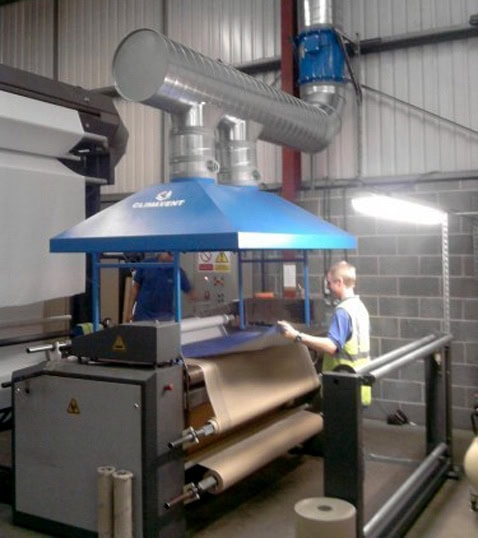
The single most consequential decision in industrial ventilation is whether contaminated air is captured at the source or merely diluted into the room.
Source Capture vs. Dilution Dilution ventilation mixes contaminated air with clean outdoor air to lower overall pollutant concentrations. While suitable for low-level, non-hazardous emissions, it disperses contaminants throughout the workspace and requires moving massive air volumes. Local exhaust captures contaminants at the point of generation, maximizing safety while significantly reducing air volume and energy demands.
Make-Up Air & Building Pressure Every cubic feet per minute (CFM) of air exhausted must be replaced. Without dedicated make-up air, a building develops negative pressure—drawing in unfiltered outdoor air, drafts, and dust through doors and gaps, straining heating equipment, and disrupting process equipment. Balanced make-up air is essential to maintaining stable operating conditions.
Controls & Energy Efficiency Operating a ventilation system at continuous full capacity wastes energy. Integrating variable-speed fan controls, static pressure reset, and equipment-interlocked dampers allows air movement to match actual process demand, substantially lowering operating costs without compromising air quality.
Engineering Solutions for Complex Industrial Environments
Every facility presents distinct physical constraints, contaminant profiles, and operational demands. Rather than applying off-the-shelf equipment, we design, fabricate, and integrate custom ventilation systems tailored specifically to your process architecture and regulatory standards.
Core Ventilation Services & Applications
Process Exhaust & Fume Extraction
Custom hood geometry and local exhaust systems engineered to capture airborne hazards—including welding fumes, chemical vapors, solvent off-gassing, and industrial dusts—at the point of generation.
Targeted Filtration & Air Treatment
Multi-stage filtration systems specified for your specific contaminant, ranging from HEPA and high-efficiency particulate collectors to wet scrubbers, baghouses, and carbon adsorption media for odor and gaseous emission control.
Custom Ductwork Design & Fabrication
In-house fabrication and precision installation of heavy-gauge, fully sealed ducting. Proper duct velocity, smooth radius elbows, and robust construction prevent drop-out, leakage, and premature static pressure losses across long runs.
Automated System Controls & Energy Recovery
Smart control integration utilizing variable frequency drives (VFDs), static pressure sensors, and equipment interlocks to adjust airflow dynamically based on real-time process demand. Heat recovery ventilators (HRVs) reclaim thermal energy from exhaust streams, significantly lowering building heating costs.
In-Plant Retrofits & System Optimization
Full-service upgrades for existing plants with minimal operational disruption. We conduct comprehensive airflow and pressure testing to diagnose bottlenecked systems, balance airflow distribution, and re-engineer legacy layouts for higher throughput and safety compliance.
- Exhaust Fan
- Fume Hood
- Air Turnover
- Make-Up Air Unit (Heat/Cool)
- HEPA Filters
- Industrial Kitchen Ventilation
- Dust Collector
- Dilution Ventilation
- Exhaust Hoods
- Source Capture Systems
- Push/Pull Systems
- Mist, Gas, Vapor Containment
- Laboratory, Medical
- Cleanroom
- Breeching, Chimney Stacks
- Environmental Control
- Tank Off-Gasing
- Process Heat Removal
- Louvers
- Gravity Ventilators
- Smoke/Fire Damper
- Control Dampers
- Intake Hoods
- Centrifugal/Axial Fans
- Utility Fans
- Grille/Diffuser
- Bag Filters, Hi-eff
- Air Curtains
- Plastic Fans
- Fan VFD
- Process Cooling Chillers
- Air Compressor Ducting
Frequently Asked Questions
What is industrial ventilation?
Industrial ventilation is the controlled movement of air in a workplace to remove or reduce contaminants such as dust, fumes, vapours, gases, mist, odours, heat, and humidity. It can include exhaust, make-up air, filtration, dilution ventilation, source capture, hoods, ductwork, fans, and controls.
What is the difference between dilution ventilation and local exhaust ventilation?
Dilution ventilation mixes contaminated air with clean outdoor air to reduce the concentration of contaminants in the space. Local exhaust ventilation captures contaminants at or near the source before they spread through the workplace. In many industrial settings, source capture is preferred when contaminants are hazardous, concentrated, or generated close to workers.
When does a building need make-up air?
A building usually needs make-up air when exhaust systems remove enough air to create negative pressure or performance problems. Make-up air replaces exhausted air so doors, fans, combustion equipment, heating, cooling, and pressure relationships continue to operate properly.
Why is my exhaust fan running but the space still smells dusty, smoky, or contaminated?
A fan can be operating and still fail to control the problem if the hood is too far from the source, airflow is too low, ductwork is restricted, filters are loaded, make-up air is missing, or cross-drafts are pushing contaminants away from the capture point. A site review can identify whether the issue is airflow, capture, pressure, filtration, or system design.
Do you handle industrial ventilation retrofits?
Yes. Arvin works on both new systems and existing ventilation systems that need repair, replacement, redesign, or performance improvement. Many projects involve adapting ventilation to new equipment, new processes, building changes, or systems that were not properly matched to the application.
What types of facilities does Arvin serve?
Arvin serves industrial, commercial, institutional, laboratory, medical, manufacturing, warehouse, controlled environment, and process-driven facilities across Hamilton, Stoney Creek, the Golden Horseshoe, and Southern Ontario.
Talk to Arvin About Your Industrial Ventilation Project